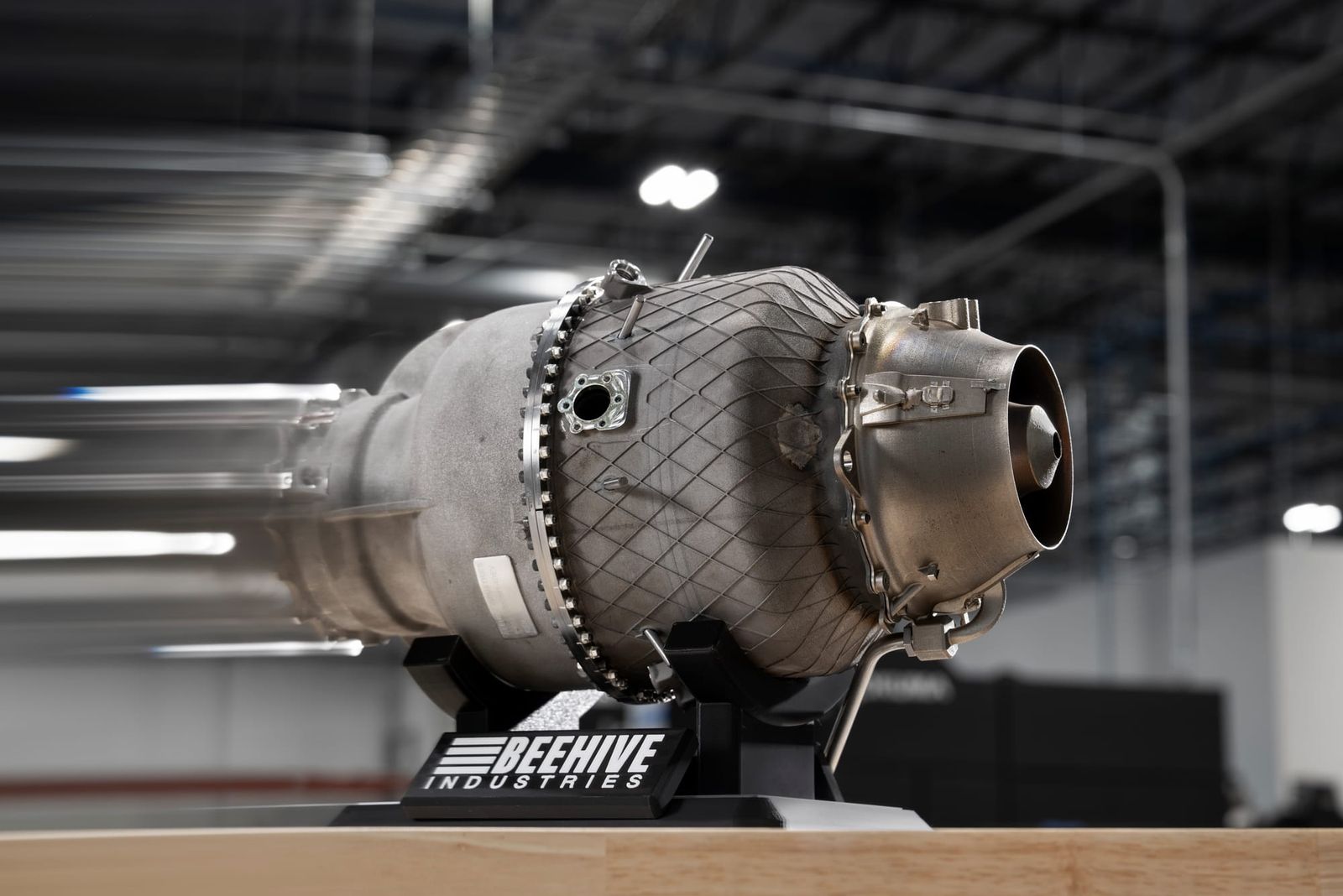
Beehive Industries is expanding its additive manufacturing capacity with a more than $50-million investment in EOS systems to ramp up production of its 3D-printed jet engines.
The US-based propulsion manufacturer said it will deploy 30 EOS M4 ONYX metal additive manufacturing machines across its Colorado and Tennessee facilities over the next 12 months, bringing its total fleet of EOS systems to 50.
The move aims to scale output of Beehive’s Frenzy 8 engine line, a propulsion system designed for swarm-class drones and other unmanned aerial systems where affordability and high-volume production are critical to defense programs.
The EOS M4 ONYX platform, which Beehive selected for the expansion, uses a six-laser system designed to increase throughput while maintaining process stability and part quality. The system also includes advanced monitoring and powder filtration features intended for aerospace and defense-grade production environments.
“Our expanded collaboration with EOS and this substantial investment in best-in-class 3D printers will significantly increase our production capacity while reinforcing our commitment to delivering scalable, American-made propulsion solutions that strengthen warfighter capabilities,” Beehive COO Darius Ehteshami said.
Additive Manufacturing Expands Across US
Beehive’s investment reflects a broader shift in US defense manufacturing, where additive production is increasingly being used to accelerate output of critical aerospace and propulsion systems.
In April, GKN Aerospace and the US Air Force Research Laboratory launched an $8.4-million program to advance titanium-based additive manufacturing for aerospace structures, focusing on scaling near-net-shape production for large aerostructures.
That same month, Stratasys joined a US Department of Defense initiative under the Joint Additive Manufacturing Acceptability IV Pilot Parts Program, aimed at validating 3D-printed components for military platforms and improving certification processes.
Also in April, Nuburu and Maddox Defense advanced their joint venture to Phase I, beginning US-based manufacturing activities in Houston focused on additive production infrastructure and counter-drone systems.
The US Navy’s Naval Air Systems Command also awarded Colibrium Additive a $3-million contract to develop metal additive manufacturing capabilities for naval aviation.