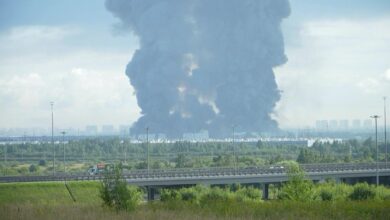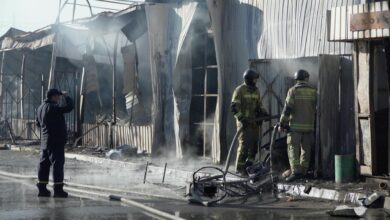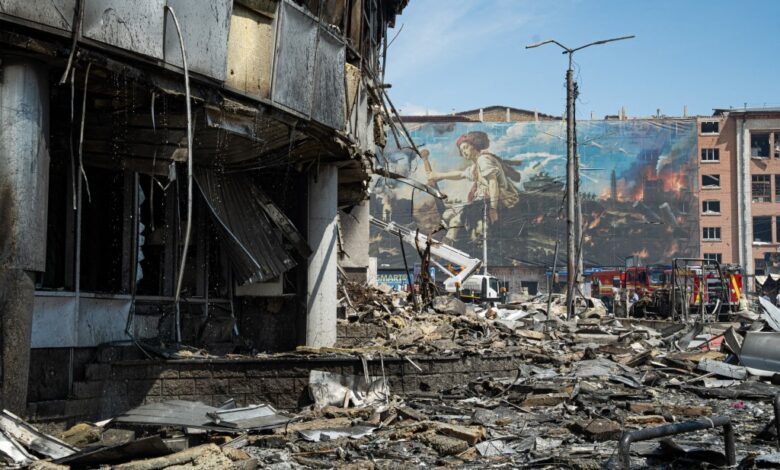
Russia’s massive aerial assault on Kyiv and Dnipro on June 2 — one of the most intense bombardments of the war — has been widely interpreted as evidence of renewed Russian strength.
More than 30 ballistic missiles, accompanied by waves of drones, tore through civilian infrastructure and residential towers. Yet the most important signal from this operation is not about capability but about depletion.
The week-long prelude of public threats, evacuation warnings to diplomats, and unusually explicit Kremlin messaging was not the behavior of a military confident in its operational tempo. It was the behavior of a state attempting to extract maximum psychological leverage from a limited window of accumulated munitions.
Russia’s decision to telegraph the attack so loudly reflects a structural reality: its ability to generate sustained, high-intensity strike packages is increasingly constrained by industrial bottlenecks, supply-chain fragility, and battlefield attrition.
Illusion of Escalation Dominance
The dominant narrative in Western and Russian media frames the June assault as either proof of Russia’s inexhaustible arsenal or a precursor to Ukrainian collapse. Both interpretations miss the underlying mechanics of authoritarian warfare under prolonged attrition.
Russia’s synchronized, high-volume strikes are not evidence of a stable baseline capability. They are evidence of a system that must ration its most advanced assets and rely on episodic surges to maintain the illusion of escalation dominance.
The Kremlin’s reliance on psychological terror — rather than battlefield maneuver — signals a shift from strategic initiative to strategic compensation.
Independent tracking organizations estimate that Russia continues to suffer tens of thousands of casualties monthly, forcing tactical adjustments and limiting the availability of trained personnel for offensive operations.
Meanwhile, Ukraine has expanded the geography of the conflict by striking industrial and logistics hubs deep inside Russian territory, including targets more than a thousand kilometers from the front. These attacks impose real costs on Russia’s defense-industrial base and complicate its ability to sustain long-range aviation operations.
The June bombardment must therefore be understood not as a demonstration of Russian strength, but as a reactive attempt to reassert narrative control after months of battlefield stagnation and industrial strain.
The Pulse-Strike Model
The industrial cost of Russia’s mixed-payload barrages is the clearest indicator of structural weakness. Launching hundreds of drones and missiles in a single operation requires months of accumulation.
Russia’s defense-industrial base has expanded significantly since 2022, but it remains constrained by dependence on imported microelectronics, limited production lines for advanced ballistic systems, bottlenecks in explosives manufacturing, and vulnerability to Ukrainian strikes on refineries and logistics hubs.
These constraints force Russia into a “pulse-strike” model: long periods of stockpiling followed by short bursts of high-intensity firepower.
Analysts at CSIS and RUSI have noted that Russia’s monthly missile output remains well below the levels required to sustain continuous high-volume barrages, and that its reliance on foreign components — particularly microchips sourced through third-party intermediaries — creates persistent vulnerabilities.
Moscow increasingly relies on saturating Ukrainian defenses with cheap loitering munitions to force the expenditure of expensive interceptors, a strategy with diminishing returns.
Ukraine has adapted with layered defenses, mobile launchers, and domestically produced drones that complicate Russian targeting.
Western partners have accelerated the delivery of air defense systems, blunting the impact of Russia’s saturation tactics. Ukraine’s interception rates for cruise missiles and drones remain high, even under saturation conditions, while Russia’s ballistic missiles — though harder to intercept — are being used at a rate that outpaces production.
Airpower as Strategic Substitute
The psychological dimension of the June assault is equally revealing. The Kremlin’s week-long buildup of threats and warnings was designed to amplify fear and uncertainty and reflects a political system that must manufacture the appearance of momentum to maintain domestic legitimacy.
Authoritarian regimes under strain often resort to theatrical displays of power to mask internal vulnerabilities. Russia’s bombardment fits this pattern: a high-visibility operation aimed as much at the Russian public as at Ukraine or the West. But the reliance on airpower is itself a sign of strategic paralysis.
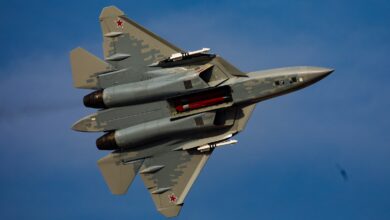
Ukrainian drone defenses have made large-scale mechanized advances extremely costly, forcing Moscow to lean more heavily on long-range aviation.
Airpower becomes the default instrument when ground maneuver is constrained, and it cannot resolve the underlying structural limits of Russia’s campaign. The Kremlin’s increasing dependence on long-range strikes reflects a narrowing set of viable options, not an expanding one.
A Window Western Policymakers Should Not Waste
The implications for Western policy are significant. Russia’s episodic surges of violence are designed to test the cohesion of NATO and the resolve of Ukraine’s partners. Each high-visibility strike is calibrated to provoke debates in Washington and European capitals about escalation risks, resource commitments, and the sustainability of support.
Yet the structural weaknesses revealed by the June assault suggest that Western policymakers should resist overestimating Russia’s capacity for sustained escalation and use the current window to strengthen Ukraine’s air-defense architecture, accelerate delivery of long-range strike capabilities, and reinforce the industrial foundations required to sustain support over the long term.
The long-term implication of Russia’s June assault is clear: tactical ferocity should not be mistaken for strategic sustainability. When a state must deploy its most advanced assets for psychological effect rather than territorial gain, it signals a system operating near its operational limits.
Russia’s capacity for episodic escalation remains dangerous, but its ability to sustain high-intensity operations is eroding.
The future of the conflict will be determined not by the spectacle of periodic barrages, but by the industrial, logistical, and political foundations that support them. Russia’s June bombardment was not a sign of strength. It was a warning flare from a military machine burning through its remaining capital.

Imran Khalid is a geostrategic analyst and columnist on international affairs, with regular contributions to international outlets including Newsweek, The Hill, Foreign Policy in Focus, Nikkei Asia, Brussels Morning, Munich Eye, InfoLibre, DC Journal, Devex, Boston Herald, Japan Times, Mail & Guardian, and EU Reporter.
His commentaries have also appeared across leading European, African, and Asia-Pacific publications.
The views and opinions expressed here are those of the author and do not necessarily reflect the editorial position of The Defense Post.
The Defense Post aims to publish a wide range of high-quality opinion and analysis from a diverse array of people – do you want to send us yours? Click here to submit an op-ed.