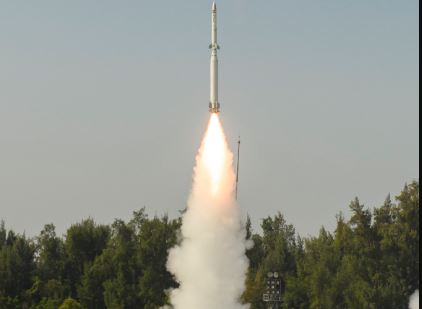

India has completed the final development trials of its Phase 2 Ballistic Missile Defence (BMD) program, marking a major step toward defending against intercontinental ballistic missile (ICBM) threats.
The system comprises two interceptors — AD-1 and AD-2 — designed to engage ballistic missile threats in both the endo-atmospheric (within the atmosphere) and exo-atmospheric (outside the atmosphere) phases of flight.
While the Indian Ministry of Defence said the system can engage ICBM targets, The New Indian Express reported that the recent demonstrations involved missiles with ranges of 2,000 to 5,000 kilometers (1,243 to 3,107 miles), typically classified as intermediate-range ballistic missiles.
ICBMs are defined as ballistic missiles with ranges exceeding 5,500 kilometers (3,418 miles).
“The interceptors successfully engaged their respective targets. The systems are designed and developed with the latest technologies to address the emerging missile threats,” the ministry stated.
“These tests have put the country in the elite group of nations having BMD capability to engage up to Intercontinental Ballistic Missiles.”
Multi-Phase Development
The BMD program was launched in 1999 in the aftermath of Pakistan’s 1998 nuclear tests. It achieved its first major milestone in 2006, when a Prithvi-II ballistic missile was successfully intercepted in an endo-atmospheric engagement at an altitude of about 48 kilometers (30 miles).
Phase 1 of the program, intended to protect India’s national capital, New Delhi, and financial capital, Mumbai, was completed in 2019.
It consists of the Prithvi Defence Vehicle and Advanced Air Defence interceptors, which can engage targets at altitudes of approximately 100 kilometers (62 miles) and 25 kilometers (15.53 miles), respectively.
The system relies on the indigenous Long Range Tracking Radar (LRTR), which was developed using technology derived from the Green Pine radar produced by Israel Aerospace Industries.
The original Green Pine radar has a detection range of around 800 kilometers (497 miles), while the LRTR is reported to detect targets at distances of 1,500 kilometers (932 miles) or more.
In addition to the radar network, the BMD architecture comprises interceptor launchers, launch control centers, and a mission control center. These elements are geographically distributed and linked through a secure communications network, enabling coordinated tracking, engagement, and battle management.
India is also pursuing Phase 3 of the BMD program, which is expected to focus on countering emerging threats such as hypersonic weapons and Multiple Independently Targetable Re-entry Vehicles.